Best Under-Sink Organizers for Small Kitchens (2026): What Fits Around the Pipes
Last updated: October 2026
Disclosure: This guide contains affiliate links. If you buy through them, we may earn a commission at no extra cost to you. How we judge →
Every kitchen has one cabinet that works differently from the rest: the one under the sink, where two pipes and maybe a garbage disposal eat the middle, the floor is slightly damp by nature, and everything you store there is tall, spray-shaped, or leaking slightly.
Standard organizers fail here in predictable ways — too wide for the pipe gap, too tall for the disposal, or a pretty basket system that turns the back half of the cabinet into archaeology. So this guide starts where others don’t: with the measuring that decides what can possibly fit, then the five organizer types ranked by Drawer Score for small and rented kitchens.
Measure first: the 4 numbers that decide everything
- Cabinet width and depth — door frame to door frame, not the interior walls.
- The pipe map. Where do the water lines and drain sit — center, left, right? How much clear floor is there on each side? Most under-sink space is really two narrow side bays plus a shallow front strip.
- Disposal clearance. If you have a garbage disposal, measure from its lowest point to the cabinet floor. Anything taller than that number lives somewhere else.
- Door swing and hinge side. Pull-out organizers need their slide path clear of the door and hinges.
An organizer that fits your measurements beats a “best overall” pick that fits someone else’s sink. Now the types.
At a glance
| Organizer type | Drawer Score | Verdict |
|---|---|---|
| 2-tier sliding basket organizer | 85 | Earns the Drawer ✓ |
| Single-tier pull-out organizer | 82 | Earns the Drawer ✓ |
| Stackable open-front bins | 78 | On Probation |
| Over-cabinet-door rack | 68 | On Probation |
| Under-sink turntable | 45 | Doesn’t Earn It ✗ |
1. 2-tier sliding basket organizer — 85/100
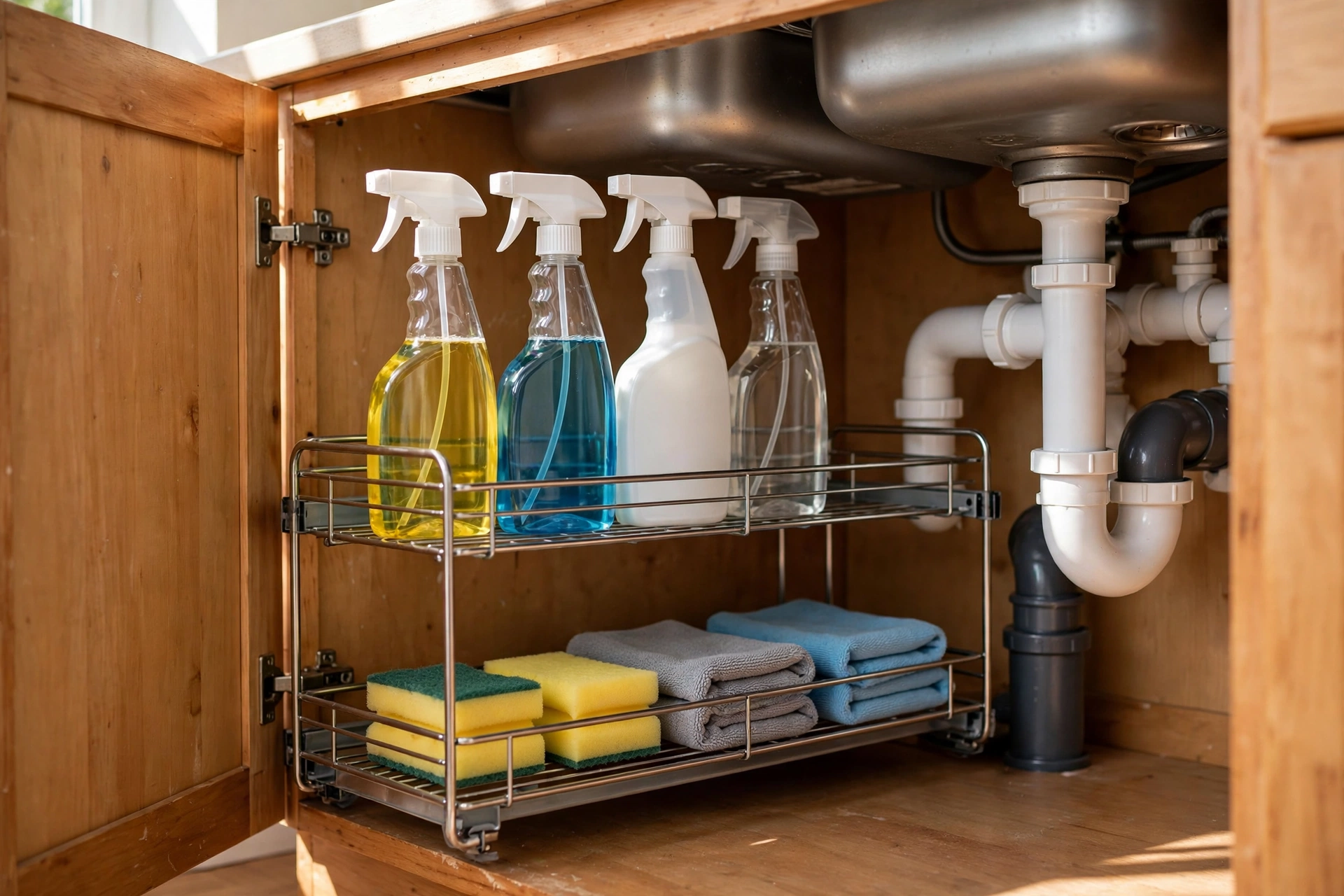
The best answer for most small sinks, and it’s not close. Two stacked baskets on a frame: the top tier slides out, so the back of the cabinet finally exists. The frame’s legs straddle the drain pipe in most layouts, and the narrow footprint (typically ~14-16 in wide) respects the side-bay reality from the measuring section.
Storage logic: tall spray bottles below, small bottles and sponges up top. A week’s supplies visible in one pull.
The drawback, honestly: assembly is fiddly (15 minutes of small parts), the sliding tier’s capacity is smaller than photos suggest, and cheap versions wobble — check that the frame is metal and the baskets are rated for the weight of full detergent bottles.
Rent note: fully freestanding. Zero installation, zero landlord issues.
Skip it if: your disposal hangs so low that even the lower tier’s bottles don’t clear — measure number 3 decides.
2. Single-tier pull-out organizer — 82/100
One sliding basket or tray on rails, mounted with screws or strong adhesive pads. Lower capacity than the 2-tier, but it’s the sturdiest option here and the best pick for heavy bottles (the big detergent, the vinegar jug) that make stacked frames sway.
The drawback, honestly: you give up the vertical doubling, and adhesive mounting on damp cabinet floors can let go over time — screw-mount if you’re allowed, adhesive if you’re renting and accept a possible re-stick.
Skip it if: your cabinet floor is uneven or water-damaged; slides bind on warped floors.
3. Stackable open-front bins — 78/100 — On Probation
The flexible-budget option: clear bins that stack two high and let you grab from the front without unstacking. They fit weird pipe maps better than any fixed frame, because you place them around obstacles, bin by bin.
Why only probation: the system lives or dies on your discipline. The moment a bin gets overfilled, the front opening becomes a spill slot, and “stackable” quietly becomes “the bottom bin is a time capsule.” Two high is the honest limit; three high is a lie we have all told ourselves.
Skip it if: you know you won’t maintain the system. The 2-tier slider forgives; bins don’t.
4. Over-cabinet-door rack — 68/100 — On Probation
Hooks over the cabinet door and holds wraps, bags or a few bottles in the dead space between door and pipes. As a supplement it’s clever — cling film and foil finally have a home. As a primary organizer it’s too shallow and too few.
The drawback, honestly: two, and both recur in owner reviews. Door clearance — the rack can bang the frame or stop the door closing flush — and weight: hang heavy bottles and some doors sag or the hooks scratch the finish. Renters, check your door’s top edge for clearance and pad the hooks.
Skip it if: your cabinet doors are inset or your pipes sit close behind the door line.
5. Under-sink turntable — 45/100 — Doesn’t Earn It ✗
The idea is lovely and wrong for this cabinet. A spinning tray under a sink means: round footprint in a rectangular, pipe-split space (the corners — your best storage — go unused), bottles toppling off the back into the pipe zone when you spin, and a tray diameter that usually fits only one side bay anyway. Turntables earn their keep in deep pantry shelves and fridge corners. Under the sink, they manufacture a junk orbit. Hard pass.
How to buy in the right order
- 2-tier slider if it fits your pipe map — it’s the system.
- Add the door rack later only if wraps and bags are homeless.
- Choose bins instead of the slider only when your pipe layout defeats every frame.
Heavy bottles only? Start with the single-tier pull-out.
FAQ
Will a 2-tier organizer fit next to a garbage disposal? Usually yes on the opposite side bay — the frames are narrow by design. Your deciding numbers are disposal clearance (measure 3) and side-bay width. If the disposal is centered and low, bins around it beat any frame.
What about the damp? Metal frames with coated baskets handle under-sink humidity fine; fabric bins and cardboard anything do not. If you have an active leak, no organizer fixes that — fix the leak first.
Renting — what won’t damage anything? The 2-tier slider and bins are fully freestanding. Door racks are damage-free if you pad the hooks and mind the door clearance. Adhesive pull-outs are the only mild risk (residue); screws are the only real commitment.
The Drawer Verdict (overall): Measure the pipes, then buy the slider. Under-sink order comes from respecting the plumbing, not fighting it.
Disagree with a verdict? Tell us what earned your drawer — hello@earnthedrawer.com.
Researched & written by the Earn The Drawer editors. How we research →
2 Comments