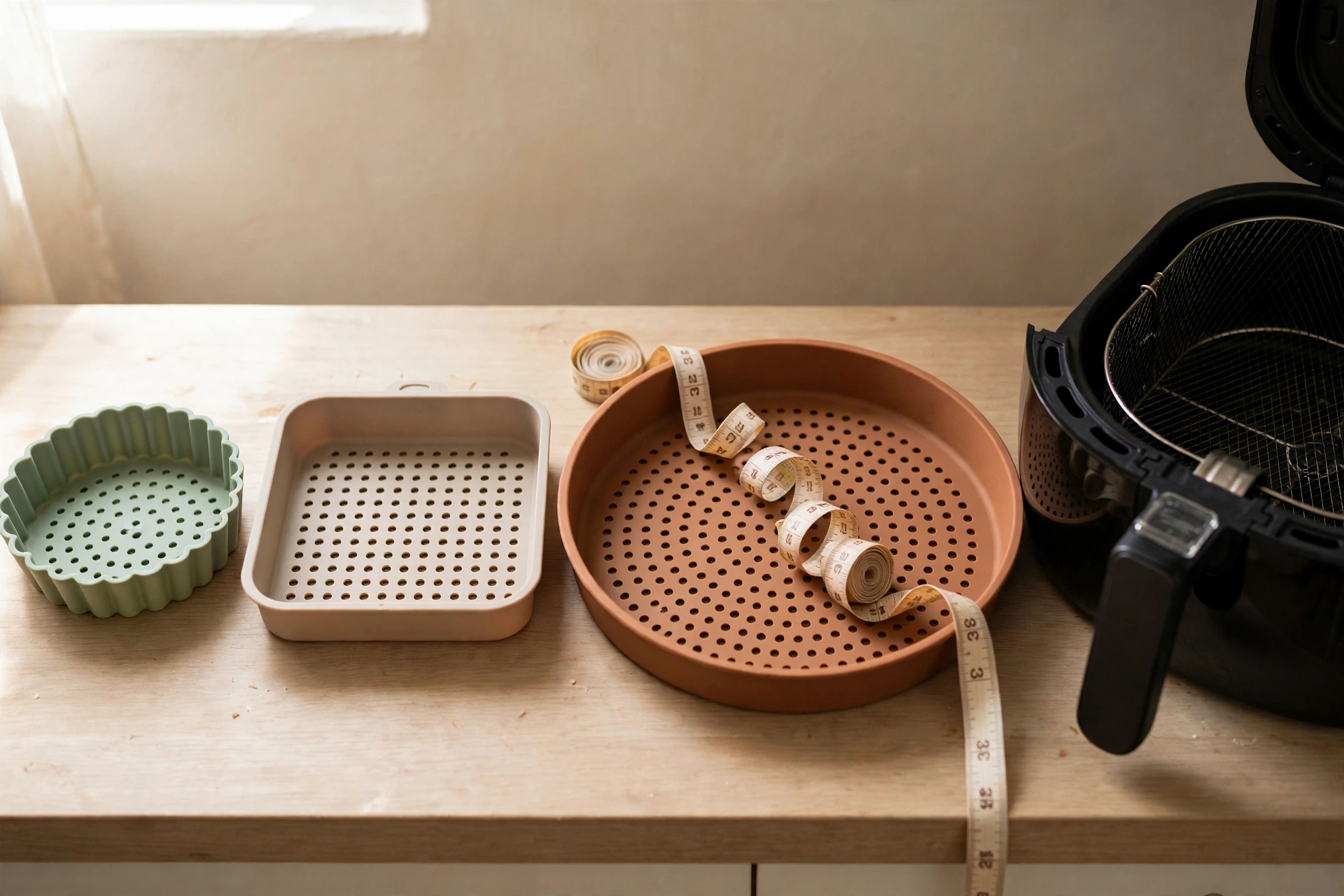
Best Silicone Air Fryer Liners: The Size Guide for Ninja, Cosori & Instant (2026)
Last updated: October 2026
Disclosure: This guide contains affiliate links. If you buy through them, we may earn a commission at no extra cost to you. How we judge →
The number one reason air fryer liners disappoint has nothing to do with quality. It’s size. A liner an inch too small leaves a moat of grease around the edge; an inch too big, and it folds up the basket wall, blocks airflow, and can touch the heating element.
Listings make it worse: most are sold by the fryer’s capacity (“fits 5-7 qt!”) rather than by the measurement that matters — the flat base of your actual basket. This guide fixes that. Below is the size to buy for the fryers people actually own, the 30-second measuring method if your model isn’t listed, and the safety rules that come with any liner.
This page is the sizing companion to our air fryer accessories guide, where liners earned a Drawer Score of 84/100. Here we go deep on fit.
The size table: Ninja, Cosori & Instant
Buy by the liner’s stated base size, in the shape of your basket. When a range is given, choose the smaller end if your basket tapers.
| Fryer | Basket shape | Liner size to buy |
|---|---|---|
| Cosori Mini 2.1 qt | Square | 6.5 in square |
| Cosori 3.7-4 qt (incl. Lite 4 qt) | Square | 7.5 in square |
| Cosori Pro 5.8 qt | Square | 8.5 in square |
| Cosori Dual Blaze 6.4 qt | Square | 8 in square |
| Cosori Dual 9 qt (twin baskets) | Square ×2 | 7.9 in square, one per basket |
| Ninja AF101 4 qt | Round | 7.5-8 in round |
| Ninja AF161 Max XL 5.5 qt | Round | 8.5 in round |
| Ninja Foodi DZ201 8 qt dual | Rectangular ×2 | ~8.7 × 5.9 in per basket |
| Ninja Foodi DZ401 10 qt dual | Rectangular ×2 | ~9.3 × 6.3 in per basket |
| Instant Vortex Mini 2 qt | Square | 6.5 in square |
| Instant Vortex 6 qt | Square | 8.5 in square |
| Instant Vortex Plus dual basket | Rectangular ×2 | ~8.7 × 5.9 in per basket |
Three reading notes before you order:
- Silicone sizes are nominal. A liner sold as “8 inch” is usually 8 inches across the top, with a base roughly half an inch smaller. That taper is why the table works — the base is what sits on your basket floor.
- Dual baskets are two small baskets. Always buy two liners (or a made-for-dual rectangular pair). One big liner folded across both sides blocks the middle airflow and cooks unevenly.
- Square fryer, round liner (or the reverse) wastes about a fifth of the floor. It works in a pinch; it is not the fit to buy on purpose.
How to measure your basket in 30 seconds
If your model isn’t in the table — or you don’t trust the listing — measure the thing itself:
- Pull the basket out and empty it. Measure across the flat floor of the basket, not the top opening. Baskets taper; the floor is the smaller, honest number.
- Note the shape honestly. Square with rounded corners is still square.
- Subtract a small margin. Your liner’s base should be equal to the floor measurement or up to ~0.5 in smaller. A liner that presses flat against all four walls starves the edges of airflow.
That’s it. Floor width + shape + small margin beats every “fits most 5-7 qt fryers” claim on the internet.
Silicone vs. parchment: which liner should you actually buy?
| Reusable silicone | Perforated parchment | |
|---|---|---|
| Drawer Score here | 84 — Earns the Drawer ✓ | 74 — On Probation |
| Cleanup | Rinse or dishwasher | Toss it |
| Crisp on the bottom | Slightly softer | Slightly better (perforations) |
| Cost over a year | One purchase | A few cents, every cook, forever |
| Best for | Saucy, marinated, cheesy food | Delicate fish, sticky dumplings, lazy nights |
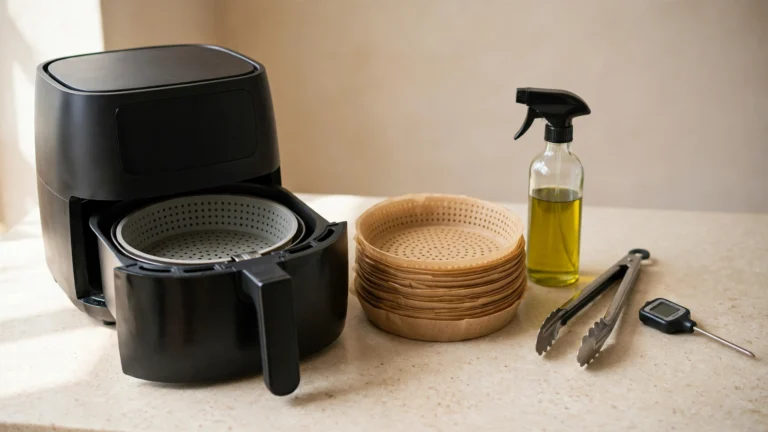
| Storage | One slot, nests flat | A stack in the same slot |
Our take: silicone is the default for small kitchens — no forever cost, no extra trash, and it survives the dishwasher. Parchment is the specialist you keep a small stack of for fish night. Both follow the same safety rules below.
The safety rules (read once, applies forever)
- Never preheat with an empty liner in the basket. Silicone is light; parchment is lighter. The fan can lift either into the heating element. Liner goes in with the food, or after preheating, weighed down by the food. This is the rule behind most liner horror stories, and it is completely avoidable.
- Keep clearance from the top element. A liner that’s too tall or curling up the walls reduces the gap. If your liner’s rim stands above the basket’s food line, it’s the wrong size.
- Don’t exceed the liner’s temperature rating. Most food-grade silicone is rated to 450°F (230°C). Air fryers that run hotter than that are rare, but check your model if you use max-crisp modes.
- Let it cool before you grab it. Silicone holds heat and hides hot grease in its ridges. Lift it out with tongs once it has sat for a minute.
What it’s bad at (the honest section)
A liner — any liner — interrupts direct airflow to the bottom of the food. Fries and wings will be a touch less crisp on the underside than cooking bare on the crisper plate. Grooved/ridged silicone minimizes this by lifting food off the surface, which is why we recommend ridged designs over flat ones. If maximum crust is the entire point of tonight’s cook, skip the liner and accept the washing-up.
Silicone also holds onto strong flavors for a wash cycle or two. The garlic-shrimp smell lingering into tomorrow’s fries is a real, if minor, owner complaint. A baking-soda soak fixes it.
Our pick
Reusable ridged silicone liner, sized from the table above — Drawer Score 84/100.
Buy the 2-pack in your size: one in the fryer, one in the wash. If you split your cooking between two basket shapes (many dual owners do), size for the basket you use most.
Perforated parchment, sized to your basket — Drawer Score 74/100.
The cleanup shortcut for fish and sticky foods, at a forever cost. Buy perforated only — solid sheets block the airflow your fryer lives on.
FAQ
Can I trim a liner that’s too big? Parchment, yes — trim it to sit flat with a margin from the walls. Silicone, no: cutting removes the reinforced rim, the edge curls, and the curl is what reaches for the element. Return it and buy the right size.
My liner came folded and won’t lie flat. Fix? One empty-basket run is not the fix (see rule 1). Soak it in hot water, then cook something heavy and flat — a chicken breast works — and it will take the basket’s shape.
Do liners work in oven-style air fryers (tray models)? Yes, sized to the tray, though the benefit shrinks: trays are easier to wash than deep baskets. The crisp penalty stays the same.
Square or round for a Ninja dual? Neither — rectangular, one per basket, from the table above. Dual baskets are the most mis-bought liners we see in reviews.
The Drawer Verdict (overall): A right-sized ridged silicone liner is the rare accessory that saves time every single week. A wrong-sized one is a fire-risk paperweight. Measure the floor, buy the size, weigh it down with food.
Disagree with a verdict? Tell us what earned your drawer — hello@earnthedrawer.com.
Researched & written by the Earn The Drawer editors. How we research →
One Comment