Best Pot & Pan Organizers for Small Cabinets (2026): Stop the Lid Avalanche
Last updated: October 2026
Disclosure: This guide contains affiliate links. If you buy through them, we may earn a commission at no extra cost to you. How we judge →
You know the sound: the cabinet-door rumble, then the lid avalanche. In a small kitchen the pot cabinet is usually one deep, dark box where pans nest inside pans, lids slide into the void between them, and retrieving the middle skillet requires removing — and re-stacking — everything you own.
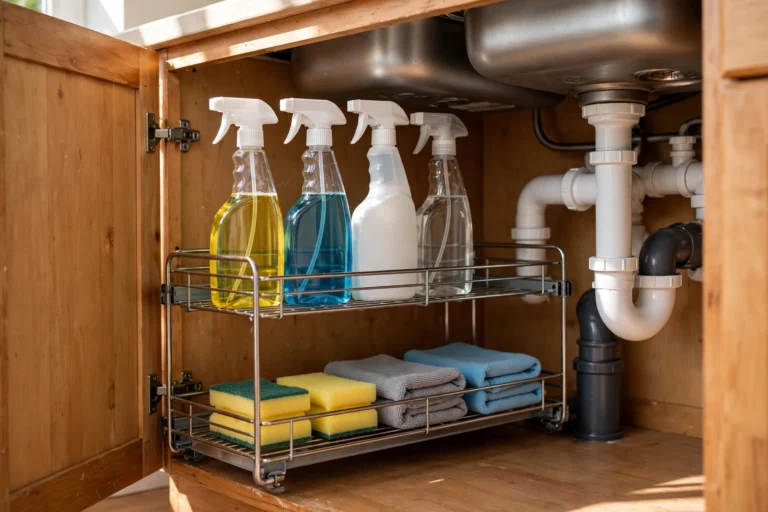
The fix isn’t a bigger cabinet; it’s changing pans from a stack to a file. Vertical storage is the whole insight of this category: every pan grabbable without moving two others. Here are the five organizer types, scored, with the failure modes their listings don’t mention. (Sibling problem, same philosophy: our under-sink organizers guide — measure first, buy second.)
At a glance
| Organizer type | Drawer Score | Verdict |
|---|---|---|
| Adjustable vertical rack (file-style) | 86 | Earns the Drawer ✓ |
| Pull-out rack with adjustable dividers | 82 | Earns the Drawer ✓ |
| Cabinet door lid holder | 72 | On Probation |
| Stackable shelf riser for cabinets | 70 | On Probation |
| Hanging rail / ceiling pot rack | 38 | Doesn’t Earn It ✗ (renters, low ceilings) |
1. Adjustable vertical rack — 86/100
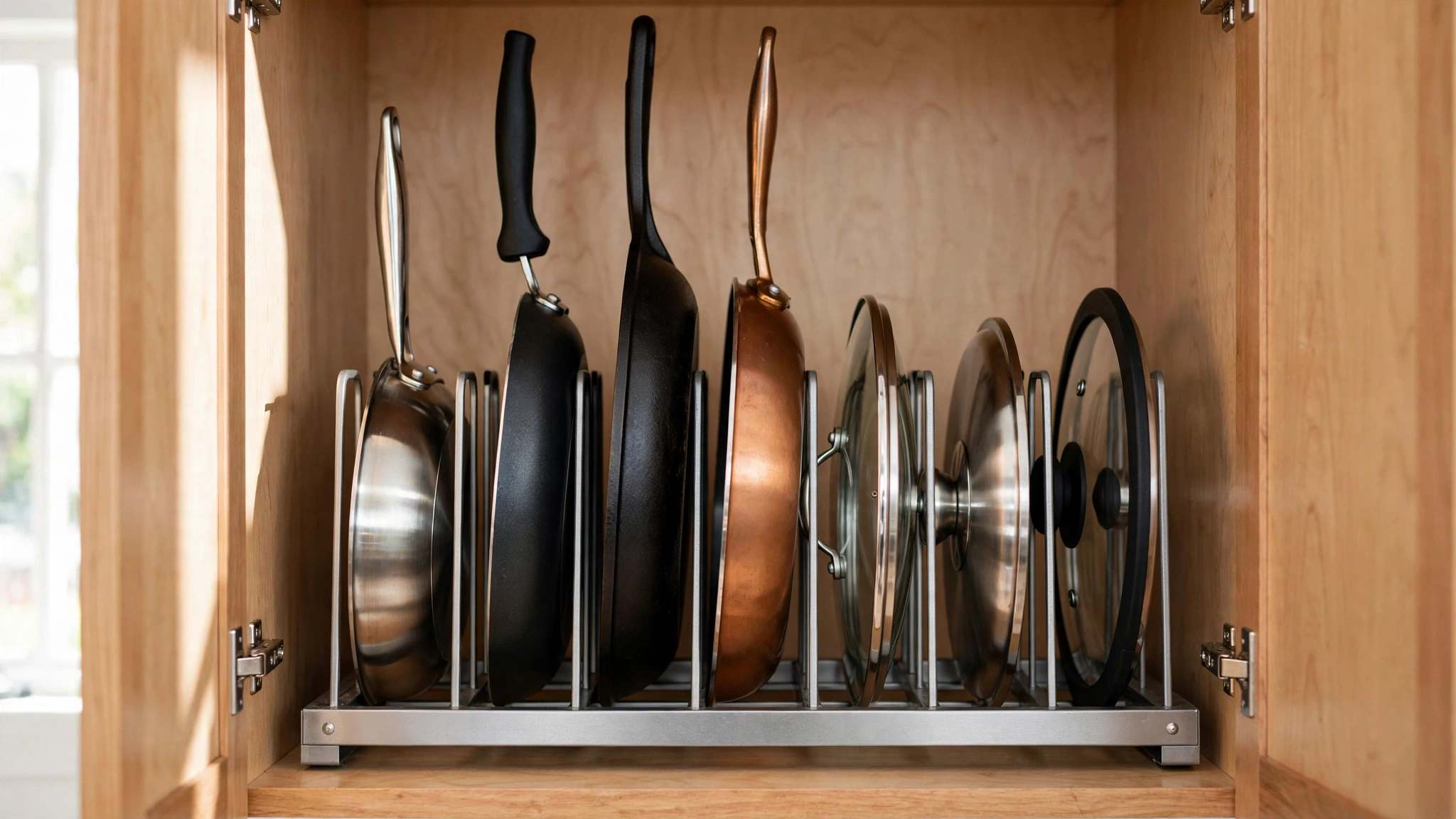
A row of U-shaped dividers on a frame; pans and lids stand on edge like files in a drawer. Adjustable spacing fits a skillet, a saucepan and three lids in the width one nested stack used to eat — and every item lifts straight out, no unstacking, no clatter.
The drawback, honestly: very heavy cast iron makes light racks flex and slide; put the heaviest pan at the end against the cabinet wall, or choose a rack with a weighted/wide base. Tall stockpots still won’t file — they keep their own corner.
Rent note: freestanding, zero installation.
Skip it if: your cabinet is too shallow for your largest pan’s diameter standing up — measure the pan, then the cabinet height. This is the under-sink lesson again: the tape measure decides.
2. Pull-out rack with adjustable dividers — 82/100
The vertical-file idea on rails: the whole rack slides out of the deep cabinet, so the back row is as reachable as the front. For deep base cabinets — the true avalanche zone — this is the deluxe answer, and the dividers keep lids filed too.
The drawback, honestly: installation. Most need screws (renters: ask, or pick adhesive-rail models and accept lower weight limits), and the slide hardware eats an inch of width each side. In a narrow cabinet that inch can be the whole deal — measure twice.
Skip it if: your cabinet has a center post or plumbing intruding (some do — check before ordering anything on rails).
3. Cabinet door lid holder — 72/100 — On Probation
Lids are the avalanche’s worst offenders — round, slidy, handle-proud. A door-mounted rack files 4-5 lids in space that was doing nothing. As a partner to a vertical rack (pans in the cabinet, lids on the door) it’s a genuinely elegant system.
Why only probation: door racks live and die by clearance. The filed lids must clear the pans when the door closes — in shallow cabinets they collide, and the door stops shutting flush. Measure the closed-door gap before you fall in love. Adhesive versions drop lids at 2 a.m. eventually; screwed versions are forever.
Skip it if: your cabinet doors are narrow, inset, or the gap test fails.
4. Stackable shelf riser — 70/100 — On Probation
A little shelf that splits one cabinet height into two levels. It doesn’t file anything, but for short items — lids on the riser, pans below, or bowls above plates — it doubles a shelf cheaply and installs in ten seconds.
Why only probation: it solves height waste, not the nesting problem. Your pans still stack; you’ve just added a floor. Legs also wander on smooth shelves unless they’re grippy.
Skip it if: your real problem is the pan stack itself — buy the file rack; this is a bowls-and-mugs tool moonlighting in the wrong cabinet.
5. Hanging rail & ceiling pot rack — 38/100 — Doesn’t Earn It ✗
Gorgeous in farmhouse photos; a bad idea in most small rentals. Ceiling racks need joists, height you don’t have, and landlord permission you won’t get; wall rails need studs and turn every pan into hanging decor you must keep grease-free because it’s on display. And in a small kitchen, pans at head height over the walkway is a concussion lottery. The look is not worth the lease clause.
The system, in buying order
- Vertical file rack — the core fix, no installation.
- Door lid holder — only after the closed-door gap test passes.
- Pull-out rack — the upgrade if your cabinet is deep and you can screw.
Riser only for the mug shelf. Rail never.
FAQ
Will vertical filing scratch nonstick pans? The dividers touch rims and edges, not cooking surfaces — that’s the quiet advantage over nesting, where surfaces grind on each other every time you unstack. Felt pads on dividers make it a non-issue entirely.
What about the stockpot and the Dutch oven? They don’t file and don’t need to: one heavy pot in its own corner is fine. Organizers are for the everyday fleet, not the two giants.
My cabinet has a lazy-Susan corner unit. Same advice? Partly — file the pans on the fixed shelves and let the corner turntable do lids and bowls, the job turntables are actually good at (unlike under the sink, where we scored them 45).
The Drawer Verdict (overall): File, don’t stack. One adjustable rack ends the avalanche for less than the cost of the pan it saves from dents.
Disagree with a verdict? Tell us what earned your drawer — hello@earnthedrawer.com.
Researched & written by the Earn The Drawer editors. How we research →